
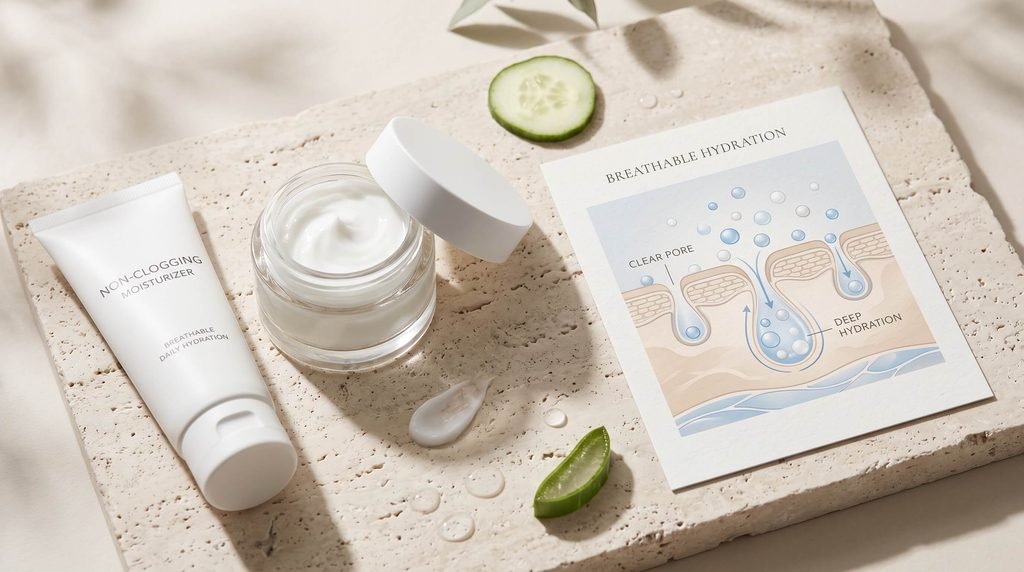
Have you ever bought a moisturizer labeled “non-comedogenic,” only to notice new breakouts after using it? It can be frustrating, especially when you are trying to take care of your skin rather than cause new issues.
The truth is that the label on the package does not guarantee the product will suit every skin type. Choosing the right moisturizer, how you use it, and the other products in your routine can all influence the result.
In this guide, you will learn how to choose a moisturizer that suits your skin, test it before applying it to your face, and monitor your skin’s response over 30 days. You will also learn how to distinguish between dryness, irritation, and new breakouts, and when it is best to stop the product or consult a dermatologist.
Step One: Select a Non-Clogging Moisturizer Before Day One
Before starting any new routine, you need to choose a moisturizer that fits your skin’s needs. You do not need to buy an entire set of products; starting with just one moisturizer is enough, so you can evaluate its effects without confusing them with the results of other products
What Does It Mean for a Moisturizer Not to Clog Pores?
The term “non-comedogenic” is used to describe products designed to be less likely to cause clogged pores.
Skin contains pores through which natural oils exit. When oils and dead cells accumulate inside pores, blackheads and whiteheads can form, which are types of acne.
Therefore, choosing a moisturizer labeled “non-comedogenic” or “won’t clog pores” can help reduce the likelihood of this issue.
However, there is an important point: this label is not a guarantee that the product will never cause breakouts for anyone. One person’s skin may tolerate a certain formula, while the same formula may not suit another.
Additionally, the presence of a specific ingredient in the ingredient list is not enough on its own to judge a product; the final formulation, ingredient concentration, and how it is used can all affect the outcome.
What should you conclude? Consider the label “non-comedogenic” as a starting point when selecting, then rely on your skin’s comfort and response with regular use.

How to Choose the Right Texture for Your Skin Type?
You don’t need to know all chemical ingredients to choose a suitable moisturizer. Start by observing how your skin behaves after washing your face and throughout the day.
If your skin is oily or acne-prone:
A lightweight gel, gel-cream, or fast-absorbing lotion might suit you. Look for products with phrases like “suitable for oily skin” or “oil-free,” alongside “non-comedogenic.”
However, the presence of oils in a product does not necessarily mean it will cause acne, nor does an oil-free product guarantee it will suit everyone.
If your skin is dry:
A richer cream or lotion might suit you, especially if you feel tightness or roughness after washing. Look for ingredients that help retain moisture and support the skin barrier, such as glycerin and ceramides.
If your skin is combination:
A lightweight lotion or gel-cream could be a suitable option. You can start with an even layer across the face, then apply a small additional amount to dry areas as needed.
Remember that skin type can be affected by weather, daily routines, and certain treatments. Therefore, do not rely on a single description of your skin year-round without noticing changes.

What Ingredients Are Worth Looking For?
When reading the ingredient list, focus on the ingredient’s function and how well it suits your skin, rather than searching for a famous ingredient just because it is popular in skincare products.
Some ingredients you might find in moisturizers include:

Glycerin: Helps draw water in and retain it in the superficial layers of the skin.
Hyaluronic Acid: Helps retain water, supporting skin hydration.
Ceramides: Lipids that help support the skin’s protective barrier and reduce water loss.
Panthenol: Used in some formulations to support hydration and skin comfort.
Niacinamide: A form of vitamin B3 that may help support the skin barrier and regulate certain aspects of oil production.
Squalane and Dimethicone: Help soften the skin and reduce moisture loss.
A moisturizer does not need to contain all of these ingredients. A simple formulation might suit you better than one containing a large number of ingredients.
Similarly, a moisturizer cannot be judged as suitable or unsuitable based on a single ingredient alone; the complete formulation and your experience with the product should be considered.
How to Avoid Ingredients That May Irritate Your Skin?
If your skin is sensitive or has reacted to a specific product before, pay attention to the ingredient list.
Fragrances, certain preservatives, or plant extracts may cause irritation or allergies in some people. For this reason, a product labeled “fragrance-free” may be a suitable choice if fragrances bother your skin.
Also, pay attention to the difference between “fragrance-free” and “unscented.” The word “unscented” means the product has no noticeable scent, but it does not always guarantee it is free from all fragrance-related ingredients.
And do not avoid an ingredient just because its name sounds chemical or unfamiliar. The best approach is to avoid what you know causes you a reaction, and choose a simple formulation if your skin is easily irritated.
Performing a Patch Test Before Using on the Face
Before introducing the moisturizer into your routine, it is best to test it on a small area of skin.
The American Academy of Dermatology recommends testing skincare products on a small area twice daily for 7 to 10 days.
Follow these steps:
1.Apply a small amount of moisturizer to a small area of skin, roughly the size of a coin, such as the inside of the elbow or lower arm.
2.Leave the product on the skin in the usual manner and duration for its use, unless the instructions state otherwise.
3.Repeat the test twice daily for 7 to 10 days.
4.Monitor for any itching, redness, swelling, or rash.
If signs of a skin reaction appear, gently wash the product off and stop using it. If the reaction is severe, seek medical advice.
However, there is an important difference: a small skin patch test helps detect certain reactions, but it does not prove that the moisturizer will not clog pores or cause breakouts on the face. Facial skin response may differ from arm skin response.
After completing the test without issue, you can begin trying the moisturizer on your face. If you already suffer from skin allergies or frequent reactions, you may need a medical evaluation rather than relying solely on a home test.
Step Two: Learning How to Apply Moisturizer Correctly
Choosing the right product is an important step, but how you use it matters too. Harsh cleansing, using an inappropriate amount, or combining multiple irritating products can make evaluating the moisturizer much harder.
Cleanse Your Face Gently Before Moisturizing
Start by washing your hands, then use a gentle facial cleanser and lukewarm water.
Apply the cleanser with your fingertips without harsh scrubbing, then rinse and pat your face dry with a clean, soft towel.
Usually, cleansing the face twice a day—morning and night—and after heavy sweating is enough. Dry or sensitive skin may require a gentler routine depending on its condition.
Avoid using harsh scrubs, very hot water, or washing your face too many times to remove oils. Excessive cleansing can cause dryness and irritation, and it doesn’t mean the skin is cleaner or that the moisturizer will work better.
Apply Moisturizer to Slightly Damp Skin
After washing your face, you don’t need to dry it completely. Leave it slightly damp, then apply the moisturizer.
This method helps lock water into the skin, especially if it is dry. However, there is no need to apply the product while water is dripping from the face; the goal is just for the skin to be slightly damp.
If you use a serum or acne treatment, follow the product instructions or the plan recommended by your doctor. In a standard routine, treatment products come according to their instructions, followed by the moisturizer, and sunscreen comes at the end of the morning routine.
What Is the Right Amount of Moisturizer?
There is no single amount that fits all moisturizers because the texture, product concentration, and application method vary from one product to another.
Start with an amount that allows you to cover your face with a thin, even layer, following the package instructions.
To apply it easily:
1.Place a small amount on your clean fingertips.
2.Distribute it across the forehead, cheeks, nose, and chin.
3.Smooth the moisturizer gently until the layer covers the areas needing hydration.
4.Pay attention to areas near the nose and jawline if you notice they dry easily.
You don’t need to scrub your face hard or massage it for a long time.
If you feel tightness minutes after application, you may need a small additional amount or a more suitable formula. If your face remains uncomfortably greasy, try reducing the amount slightly before deciding to change the product.
And do not skip moisturizer entirely just because your skin is oily; oily skin can also suffer from dryness or irritation.
How to Order Skincare Steps Morning and Evening?
In the morning:
1. Cleanse your face gently.
2.Use any treatment or lightweight product already in your routine, according to its instructions.
3.Apply the moisturizer.
4.Use a broad-spectrum sunscreen with SPF 30 or higher.
Let the moisturizer settle into the skin, then apply sunscreen. The American Academy of Dermatology recommends applying sunscreen about 15 minutes before going outside, reapplying every two hours while outdoors, and after swimming or sweating.
Sunscreen helps protect the skin from UV rays, but it does not replace a moisturizer if your skin needs hydration.
In the evening:
1.Remove makeup or sunscreen when needed.
2.Cleanse the face gently.
3.Use your usual acne treatment if you use one, according to your doctor’s or the product’s instructions.
4.Apply the moisturizer.
If you are using a treatment prescribed by your doctor, do not change how you use it or stop it just because you started trying a new moisturizer. The goal is to evaluate the moisturizer without disrupting the core treatment.

Step Three: Days 1 to 7 — Monitoring Skin Comfort
During the first week, do not expect your skin to change drastically in a few days. Focus on whether the moisturizer feels comfortable and whether it causes unwanted symptoms.
Keep the Rest of Your Products Consistent
Use your cleanser, sunscreen, and usual treatments in the same way as much as possible.
Try not to add a new serum, exfoliant, mask, or acne treatment during this period without need. Introducing multiple products at once makes it harder to know the cause of any change.
If you are already using a prescribed acne treatment, continue according to your doctor’s guidance. Do not stop the treatment, change its dosage, or frequency just to maintain the test.
Why Is This Important?
Suppose you started a new moisturizer and a new exfoliant on the same day, and then redness appeared on your face. It would be hard to know which product caused the issue. But if the rest of the steps remain constant, your observations become much more useful.
What Should You Record Every Day?
Dedicate one minute in the evening to write short notes. You can use your phone’s notes app instead of buying a special notebook or tool.
Record four things:
1.Comfort level: Do you feel your skin is comfortable, tight, dry, or uncomfortably oily?
2.Signs of irritation: Did you notice itching, redness, flaking, swelling, or a rash?
3.Sensation after application: Did a tingling or burning sensation appear? When did it start? Did it persist or disappear quickly?
4.New breakouts: Where did they appear? Did you notice them recurring in the same area after applying the moisturizer?
You can format your notes like this:
–Day: 1
-Comfort after application: Good.
-Dryness: Mild around the nose.
-New breakouts: No noticeable change.
-Additional note: None.
You don’t need to see a difference every day; rather, you are gathering information to help you compare later.

How to Deal with Irritation in the First Week?
Skin reactions may not appear the first time. Some forms of irritation or allergy can appear hours or days after exposure to the triggering substance.
If you notice persistent burning, itching, increasing redness, or swelling, stop using the moisturizer and wash it off gently.
Do not try to fix the problem by adding several new creams or products on your own. If the reaction is severe or persists after stopping, seek medical advice.
If severe swelling of the face, lips, or tongue occurs, or difficulty breathing, seek emergency medical help.
Step Four: Days 8 to 21 — Establishing the Routine and Evaluating the Amount
Days 8 to 14: Sticking to a Consistent Method
Continue using the moisturizer according to your skin’s needs and the product instructions.
Maintain your morning and evening step order, and do not change the amount of moisturizer every day. This way, you can compare results more clearly.
Monitor whether dryness decreases, if your skin becomes tight after washing, or if the product leaves an annoying shine.
Do not consider shine alone as proof of clogged pores; it may relate to the moisturizer’s texture, product amount, or the nature of oily skin.
Days 15 to 21: Adjusting the Amount When Needed
If your skin is comfortable but the moisturizer feels heavy, try reducing the amount slightly. If dry areas remain after application, you can add a small amount to those areas.
Change only one factor at a time, then monitor the result for several days.
For example, if you apply a large amount morning and night and feel your face is constantly oily, you don’t need to change the moisturizer immediately. Start by adjusting the amount while keeping the rest of the routine consistent.
For combination skin, dry areas may need more hydration than the forehead and nose. The amount of moisturizer does not need to be identical in every area.
However, if irritation appears or acne worsens noticeably, do not continue testing just because you haven’t reached day thirty.
Why Should You Avoid Frequent Changes?
During this period, it is best not to introduce exfoliants or new treatments to speed up results.
Certain active ingredients, such as retinoids or exfoliating acids, can cause dryness or irritation for some people. If you start using them in the middle of a moisturizer test, it becomes hard to pinpoint the cause of changes.
And do not change your moisturizer because of a single pimple that appeared on a certain day. It is better to review your notes and look for a recurring pattern.
Conversely, if breakouts recur or irritation increases after using the product, do not ignore these signs and do not assume your skin needs more time no matter what.
The goal of this phase is to gather practical evidence from your experience, not to force your skin to accept a specific product.
Step Five: Days 22 to 30 — Reviewing Results and Making a Decision
By day 22, you will have notes spanning several weeks. Use them to evaluate the suitability of the moisturizer rather than relying on a single impression or photo.
Compare Your Skin to Day One
If you took photos on day one, take new ones in similar lighting, distance, and angle.
Compare the photos and notes using the following questions:
-Has the feeling of tightness and dryness decreased?
-Does the moisturizer remain comfortable all day?
-Does it leave an uncomfortably greasy layer?
-Have repeated signs of irritation appeared?
-Have you noticed a clear and continuous increase in breakouts after introducing the product?
You don’t need to notice major improvement in every aspect. The moisturizer might be successful in reducing dryness even if it doesn’t change acne itself.
Photos alone do not reveal the cause of every change. Acne can be affected by hormonal factors, other products, and treatments used, alongside other individual factors.
Are 30 Days Enough to Ensure a Moisturizer Won’t Clog Pores?
No. Thirty days is a useful review point, but it doesn’t provide a definitive guarantee.
The first month can help you discover discomfort, dryness, or frequent irritation, and evaluate the moisturizer’s texture and suitability for your routine. However, some changes related to acne may take longer to become clear.
The American Academy of Dermatology points out that studies on moisturizers suited for acne-prone skin found improvement in many participants within 4 to 8 weeks, but this was within plans that included acne treatment, cleanser, and moisturizer, rather than just using the moisturizer alone.
Therefore, do not consider the passage of 30 days as proof that the product will never cause pore clogging in the future. At the same time, do not assume the appearance of a single pimple proves the moisturizer is the cause.

Do New Breakouts Mean the Skin Is Purging?
The term “purging” refers to a temporary increase in certain blemishes when starting active ingredients that affect skin cell turnover, such as certain retinoids.
However, one should not assume new breakouts represent this process just because they appeared after starting a new routine. A moisturizer alone is not an exfoliating treatment, and breakouts could be linked to an unsuitable product or another cause.
If breakouts coincide with itching, burning, or redness, irritation may be part of the problem. If acne continuously worsens, do not ignore the change under the guise of natural skin purging.
Record the timing of breakouts and the products you use, and consult a dermatologist if the problem persists or worsens.
How to Decide: Continue, Change, or Consult a Doctor?
You can continue using the moisturizer if:
–Your skin is comfortable with regular use.
–Frequent signs of irritation have not appeared.
-Hydration suits your needs.
-You haven’t noticed a clear pattern of increased breakouts after using it.
Consider stopping or changing the product if:
-It leaves a heavy or uncomfortably greasy layer despite adjusting the amount.
–You notice frequent irritation after using it.
–Breakouts recur noticeably after introducing it to your routine.
If clear signs of allergy or irritation appear, stop using it rather than continuing the test until day thirty.
When Do You Need a Dermatologist?
Consult a dermatologist if acne is painful, severe, or leaves scars, or if it doesn’t improve despite following proper treatment, or if it significantly affects your psychological comfort.
Frequently Asked Questions About Non-Clogging Moisturizers
Can a moisturizer cause acne even though it says non-comedogenic?
Yes, this is possible. The phrase indicates a lower likelihood of clogged pores, but it does not guarantee suitability for everyone. Monitor your skin’s response and pay attention to recurring changes rather than relying on the label alone.
Does oily skin need a moisturizer?
Yes, oily skin may also need hydration, especially if it suffers from dryness or irritation due to cleansing or acne treatments. Choose a comfortable formula suited for your skin type and don’t over-wash your face to remove oils.
Should you change your moisturizer when the seasons change?
Yes, absolutely! Weather changes directly affect your skin’s hydration levels. In the hot and humid summer, your skin naturally produces more oil (sebum), so heavy creams can trap sweat and clog your pores. Instead, switch to a lightweight, water-based gel-cream or oil-free lotion.
In contrast, the cold and dry winter air strips moisture from your skin barrier, leading to dryness and irritation. To protect your skin, swap your summer gel for a richer cream formula packed with ingredients like Ceramides or Fatty Acids [ymkcap]. These lock in deep moisture and repair your barrier without clogging your pores.
How often should I use a moisturizer?
This depends on product instructions and your skin’s needs. Many people use a moisturizer after washing their face morning and night, but needs can vary depending on skin type, weather, and treatments used.
Can I use a new serum while testing the moisturizer?
It is best to postpone unnecessary new products during the evaluation period so you can clearly observe the moisturizer’s effect. As for prescribed medical treatments, follow your doctor’s instructions and do not stop or change them for the test.
Does moisturizer alone treat acne?
Not necessarily. A moisturizer’s primary function is to support hydration and reduce dryness, and it may help tolerate certain acne treatments. But it does not replace proper treatment when needed.
Conclusion
Choosing a non-clogging moisturizer is about much more than just reading a label—it is about picking the right formula for your unique skin, testing it safely, and staying consistent
30-day beginner’s skincare routine, keep the rest of your products exactly the same, listen to your skin, and give it the time to adjust. Remember, a simple routine and patient observation will always beat trying ten different products at once. Less is truly more!
You are now armed with all the knowledge you need to make the perfect choice for your skin barrier. Your glowing skin journey starts right now, and you’ve got this!
Now, we want to hear from you! What is your skin type, and which ingredient are you most excited to try next? Drop your questions or your day-1 progress in the comments below—let’s glow up together! ✨
Medical References and Sources
–American Academy of Dermatology — How to test skin care products
–American Academy of Dermatology — Why moisturizer is important for acne-prone skin
–American Academy of Dermatology — Skin care tips for acne-prone skin
–American Academy of Dermatology — How to wash your face the right way
–American Academy of Dermatology — How to apply sunscreen
–NHS UK — Contact dermatitis and its symptoms